



 EN

Dry etching Overview
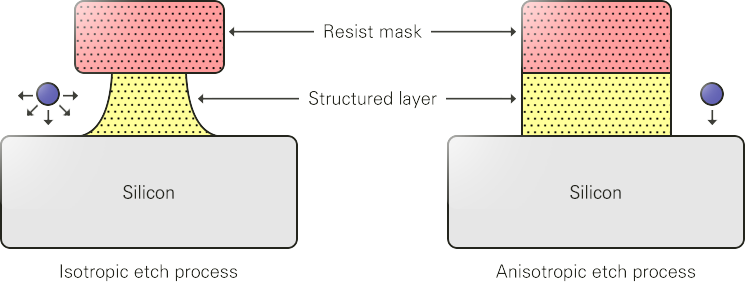
- Isotropic Etching (Isotropic Etching)
- Thin films are etched solely through chemical reactions between radicals and the film surface.
- Random radical movement results in anisotropic etching.
- High selectivity (chemical reactivity)
- Low damage to the underlying film
- Undercut occurs, making fine patterns difficult to achieve.
- Excessive chemical use raises environmental concerns.
- Anisotropic Etching (Anisotropic etching)
- Ions accelerated by self-bias promote chemical reactions
to perform etching. - Ions accelerate in one direction, resulting in minimal lateral erosion.
- High etching resolution (1 μm or less is possible)
- Physical bombardment also causes etching, so damage to the underlying film
must be considered.
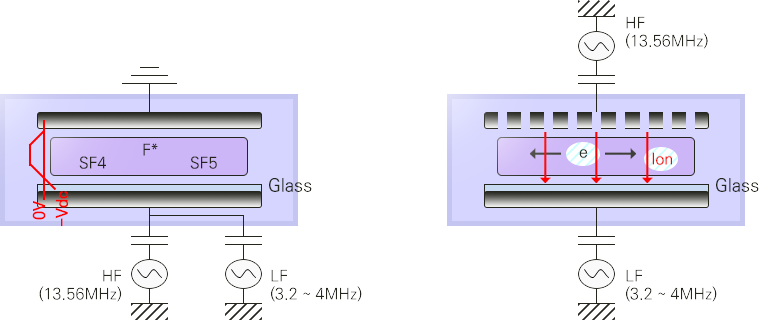
- ECCP
(Enhanced Capacitive Coupled Plasma) - Capacitively coupled plasma (CCP) is generated in a configuration with a dielectric
between parallel plates. - Although plasma density is lower than with ICP, it offers a relatively
simple way to create uniform, large-diameter plasma,
which is a key advantage. - It enables large-area etching and thin-film deposition
and is widely used in the manufacturing of semiconductor devices
and thin-film silicon solar cells.
- ICP
(Inductive Coupled Plasma) - The basic principle of inductively coupled plasma (ICP) is to pass current through
a coil-shaped antenna located outside the reaction chamber.
The induced electric field around the antenna causes electrons
to oscillate horizontally. Fewer electrons are absorbed by the electrodes, resulting in
higher electron density than other plasma sources. - This forms high-density plasma. The lower bias electrode attracts ions
to carry out etching.

Customized Solutions
INVENIA offers flexible process and design support tailored to each customer’s product characteristics and applications.
providing tailored consulting to improve process efficiency and reliability.
